About this place
A Historically Important Place
Taku Harbor sits on Stephens Passage roughly 22 miles southeast of Juneau, on the mainland coast of southeast Alaska. Accessible only by water or floatplane, it is one of the more historically layered anchorages in the region.
The harbor lies on the lands of the T’aakú Kwáan, the Tlingit people of the Taku region. The village of S’iknax̱sáankʼi stood here as a permanent, year-round community, established long before Russian mariners began hunting sea otters nearby in the 1830s. In the early 1880s it was a village of about 300 people living in two large tribal houses, making it one of the most populous communities in the area before gold was discovered at present-day Juneau.
The name has been translated as “Little One Below Black Bear Community” and as “Grindstone Town Bay.” The village and bay are also known as S’iknax Aan Geeyí.
Russian, British, and American colonists brought disease and conflict, and yet S’iknax̱sáankʼi residents persisted. The Hudson’s Bay Company built Fort Durham in the harbor in 1840 and abandoned it three years later. A salmon cannery opened in 1901 and operated until about 1950, drawing hundreds of seasonal workers each summer. The last villagers left by 1950, and the rainforest has reclaimed the village site since.
Today most of the coastline is an Alaska State Marine Park, offering protected anchorage, a float and moorage maintained by Juneau Docks and Harbors, and rugged trails through regrown forest that obscure the remains of all that came before.
Six eras
A Harbor of Many Stories
Long ago – 1950
S’iknax̱sáankʼi, Tlingit Village
A permanent year-round village of the T’aakú Kwáan at Taku Harbor, home to about 300 people in the early 1880s.
1840 – 1843
Fort Durham
The Hudson’s Bay Company’s short-lived trading post, built on land the Russian-American Company claimed and leased without any treaty.
1882 – 1884
Presbyterian Mission
The Corlies family built a church and school at S’iknax̱sáankʼi; the timbers were later rebuilt as Juneau’s Native Presbyterian Church.
1901 – c. 1950
Salmon Cannery
A cannery and Alaska’s first cold storage, running under seven owners and operators before Libby, McNeill & Libby took over in 1918.
1946 – 1986
Glacial Research and the Last Residents
Taku Harbor as a working anchorage during the icefield research era, when Tiger Olson kept the cannery site alive as its only year-round resident.
1986 – present
State Marine Park
Seven hundred acres set aside by the legislature, preserving the anchorage, the cannery remains, and the forest that has grown back over everything else.
The place today
Visiting Taku Harbor
The harbor is reachable by small boat from Juneau in calm conditions, though Taku Inlet is known for strong outflow winds, the Taku wind, that can make passage hazardous. The Juneau Docks and Harbors float provides moorage, and improvised trails run through the former cannery grounds.
Marine park information: Taku Harbor State Marine Park is managed by the Alaska Division of Parks and Outdoor Recreation. A cabin is available by reservation. Bears, both brown and black, and wolves are active in the area. The anchorage is exposed to southeast winds; the inner cove offers better protection.
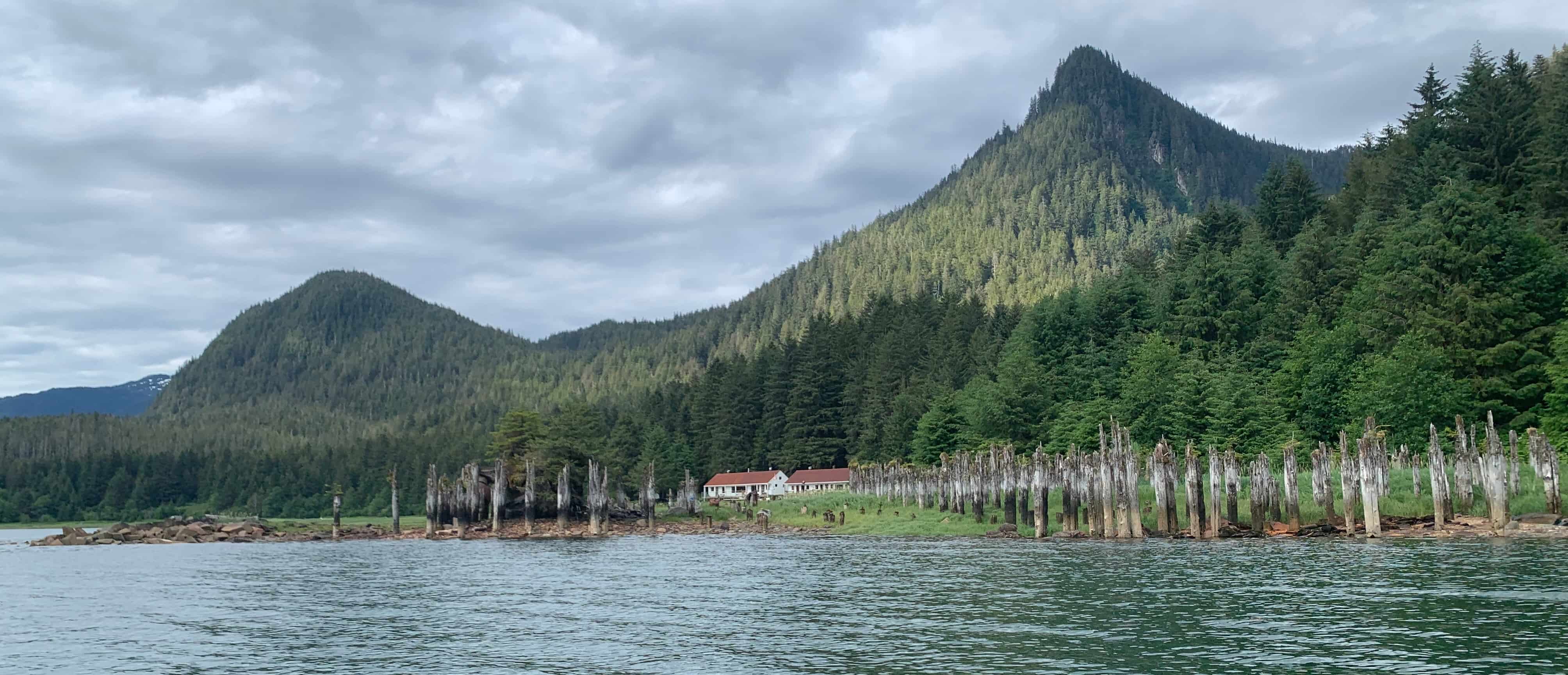
The forest has largely reclaimed the site, but two red-roofed bunkhouses built in 1916 or earlier still stand, along with weathered pilings, rusting machinery, and sheets of metal once destined to become salmon cans. The site of S’iknax̱sáankʼi has been reclaimed by rainforest. The Fort Durham site, in the northeast corner of the harbor, is fully forested; its layout is known only from archaeological investigation led by Wallace M. Olson in 1994. Fort Durham was designated a National Historic Landmark in 1978.